
Dancing comes with bhav
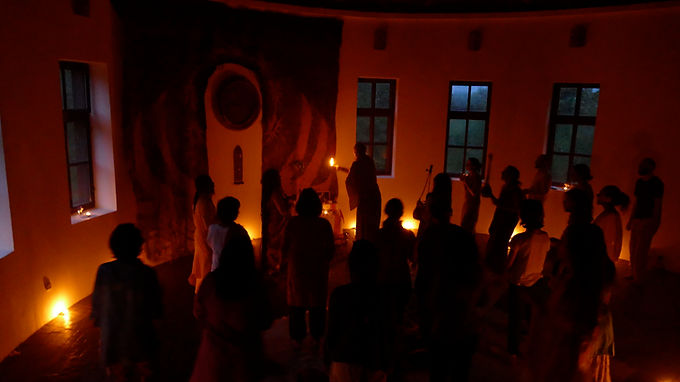
Satsang following a Baul dance session, 2 May 2018,
during Parvathy Maa’s first retreat in Hungary.
Jaya
Dancing comes with bhav
Satsang following a Baul dance session, 2 May 2018,
during Parvathy Maa’s first retreat in Hungary.
„Dance when you are broken and open. Dance when you have torn off your bandage. Dance when you are longing and yearning, Dance even in the middle of fighting. Dance in joy or in sorrow. Dance even if you are in peace.”
(Laughter) So you cannot be without dancing. True dancing comes with bhav. Bhav is a state of being in which you surrender yourself completely to the Divine. There is nothing you hold back. Because you can only dance once you have shed your ego, once you have shed your personality. And now you offer yourself completely to the Divine, to please the Beloved. So you must dance like a little girl who dances out of joy, not to show off to anyone, not to be perfect, but children dance simply because they are happy; they are expressing their happiness. Even if she is sad and angry, saying ‘No, Mummy’, she still stamps her feet – (laughter) it’s a different kind of dance, but it’s still a dance. In this way, you express yourself fully from within. For the Bauls, dance is actually meditation – a dynamic form of meditation – because, you see, it’s continuous footwork, just like meditation when we repeat a mantra or practise breathing exercises – it’s repetition, the movement of the feet here is the repetition. The movement you constantly return thus gradually becomes meditation. You move in a certain way, continuously, and this leads to stillness. The movement takes place, but within, you will find stillness. So dance is essential for this; dance is meditation, dance is bhav, a state of being in which you experience true surrender.
(One of the participants asks why we turn to the left whilst spinning.)
When we move in this direction (to the left), we are moving towards our own centre, moving inwards, whereas when we move this way (to the right), we are moving outwards, towards the outside world. Movement to the right represents fire; it evokes more action, so the mind moves physically towards the senses, towards fire, whilst the moon (the left side) represents coolness and water, thus leading to meditative energy. This is why, whilst spinning, every movement is in this direction. But when someone is simply dancing or doing something else, they move to the right, because that is the presentation of the dance, the choreography or something of that sort; but the Baul dance serves meditative purposes – its aim is for you to immerse yourself deeply within yourself and find the energy within you. That is why every movement is to the left. I think the same applies to the dervishes. And also because almost all the planets move to the left. So, even from a scientific point of view, the entire movement of the universe is directed to the left; it moves in that direction.
At the beginning, when we start practising the turning – and especially as we have a tendency to block our emotions and many other things – the movement, in a sense, purifies us, and so fresh, new energy flows into us. So you can use this even when you’re not feeling well, but when you reach that state where you’ve already been cleansed and then you start spinning, it becomes something else – it becomes meditation. It takes you somewhere else, to what’s behind these blockages and emotions, behind all of this. So first you must purify yourself, then you must go deeper and deeper, higher and higher.
(One participant says that so you should practise this both when you’re in a bad mood and when you’re in a good mood.)
In both cases. To attain what we call samatha; samatha is equanimity, remaining the same whether you are sad, happy or angry… You can feel the emotions, but honestly and truly, you must not let be affected by them. It is like maintaining a balance: to remain constantly in a meditative state. Emotions arise because we are emotional beings; every human has emotions and thoughts, but you must reach a state where you let everything come to you, like waves, whilst you yourself remain equanimous. That is why you must „Dance when you are broken and open. Dance when you have torn off your bandage. Dance when you are longing and yearning, Dance even in the middle of fighting. Dance in joy or in sorrow. Dance even if you are in peace.” In this way, everything must become the same.
To conclude, I would like to remind you that there may be practitioners who possess great talent and outstanding skills, yet they are still not content. Contentment is to find simplicity and happiness, a state of constant fulfilment. So even on this path, we may go through all kind of experiences and encounter all sorts of things, yet we may still not be content. That is why finding contentment is essential. This is precisely why devotion and self-surrender are necessary. We must practise these, because if we have only experiences, it can make us arrogant. That is why it is better to be humble, and that is why devotion is essential. In every practice, you must be very devoted in the sense that you bow, you offer; every day, before practising, you touch the floor, bow, pray and ask for a blessing, because you are nothing, just an instrument played by the divine. You must possess this humility; only then will you find contentment. This is the most important thing. This is what will make you a true practitioner. Being humble on the outside, prostrating yourself 50 times before God, does not make you humble. Humility springs from within. Always think that there is something much higher and greater, and then you will also feel that you are not in control of everything. In that way, you will be more peaceful. (Laughter.)